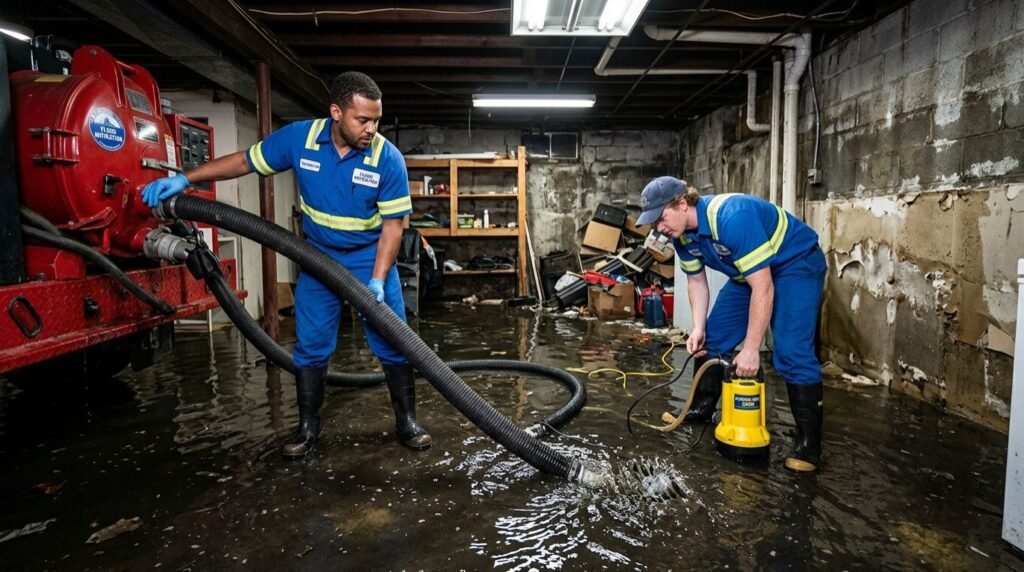
The sewage backup already happened. The smell hits you the moment you open the basement door. The floor is covered and the waterline is climbing up the drywall. And one thought crosses almost every homeowner’s mind in those first minutes: do I really need to call someone right now, or can this wait until I sort out the insurance situation?
It cannot wait. Not a day. Not over the weekend. Not until Monday when the plumber has availability.
The hour-by-hour damage timeline of an untreated sewage backup is steep and accelerating. What costs $4,000 to remediate at hour two will likely cost $15,000 or more by hour 72 – not because the work changed, but because the scope tripled. This is exactly what happens to a New York property when sewage cleanup is delayed, and why every hour of that delay carries a measurable price. If you are ready to act now, our emergency sewage cleanup team is available 24 hours a day.
What Is Actually in That Water
Understanding the contamination profile matters before the timeline makes sense.
Raw sewage is classified as Category 3 black water under IICRC S500 – the same biohazard classification as natural floodwater and storm surge. The CDC identifies organisms routinely present in raw sewage: E. coli, Salmonella, Campylobacter, Hepatitis A virus, Norovirus, Rotavirus, Giardia lamblia, Cryptosporidium, and Leptospira bacteria. Exposure occurs through direct skin contact, inhalation of bioaerosols, and indirect hand-to-mouth contact. Sewage also releases hydrogen sulfide, methane, and ammonia. In enclosed basement spaces, hydrogen sulfide causes headaches, nausea, and respiratory irritation at low concentrations – and rapid loss of consciousness at higher ones.
In NYC and Nassau County, the contamination carries an additional layer. Approximately 60% of NYC uses combined sewer systems routing sewage and stormwater in the same pipes. During heavy rain, combined sewer overflow events push untreated sewage mixed with street runoff back through basement floor drains. Elmont, Cambria Heights, South Floral Park, and parts of Ozone Park sit over aging infrastructure with this vulnerability. What comes up through the drain during a storm overflow is not solely household waste – it includes the full contents of the upstream street system.
The Hour-by-Hour Damage Timeline
The deterioration is not gradual. It accelerates.
Within the first two hours, sewage-contaminated water spreads and absorbs into every porous material it contacts – carpet, carpet padding, drywall at the base of walls, wood framing, insulation, and stored items on the floor. Bacterial colonies are active from initial contact and multiply continuously.
Between two and 24 hours, contamination is firmly established in all porous materials. Any food near the area is contaminated. Electronic components in the space begin developing corrosion on contacts from the humid, contaminated air.
Between 24 and 48 hours is where the project crosses a threshold. Mold begins germinating on sewage-saturated surfaces. The EPA and FEMA both identify this as the critical mold germination window. Sewage saturation is even more aggressive than clean water – it provides both the moisture and the organic nutrients mold needs. A cleanup-and-decontamination project at hour two becomes a cleanup, decontamination, and mold remediation project at hour 48. That distinction alone typically adds $5,000 to $10,000 to the total project cost. Our certified mold remediation service explains what that phase involves and why it cannot be skipped once colonization has started.
Between 48 and 72 hours, visible mold colonies may already be present on wall insulation, drywall backing, and wall cavities. Structural materials – particularly wood bottom plates and subfloor framing – are deeply saturated. Odors have migrated through ductwork and into textiles throughout the property.
Beyond 72 hours, materials that could have been dried in place at hour two now require full removal and regulated disposal. Mold remediation becomes a full parallel project rather than a preventive step, and structural drying cannot begin until all decontamination and material removal is complete.

The Financial Consequences of Waiting
The cost difference between acting immediately and waiting is not marginal.
A sewage backup in a Nassau County basement or NYC ground-floor unit addressed within two hours typically runs $3,000 to $7,000 for extraction, contaminated material removal, antimicrobial treatment, and structural drying to clearance. The same project at 48 hours – with mold established in wall materials – typically runs $10,000 to $18,000. Beyond 72 hours, with structural materials deeply saturated and mold actively spreading, $20,000 to $30,000 or more is a realistic total for a single finished basement.
This is not the restoration company charging more for the same work. It is genuinely more work – more material removal, a full mold remediation phase added to the project, longer drying, and a longer total timeline – because the damage has had time to compound. Finished basements cost more than unfinished ones at every delay interval because they contain more porous material: carpet, insulation, drywall, drop ceilings, and cabinetry, all of which must come out when contaminated. For a full breakdown of what sewage cleanup involves and what it costs in this market, see our comprehensive guide to sewage backup cleanup and health hazards.
The Insurance Consequence Nobody Reads Until It’s Too Late
Every homeowners insurance policy contains a duty-to-mitigate clause requiring the policyholder to take reasonable steps to prevent further damage after a covered loss.
If your policy covers the original sewage backup and you delayed cleanup long enough for mold and structural damage to develop, the insurer can deny coverage for those additional losses. The reasoning: prompt professional intervention would have prevented them. A 48-hour gap between discovery and calling a restoration company supports exactly that argument.
This is also why documenting the moment of discovery matters. A time-stamped photograph at the moment you found the backup creates an unambiguous record of when you first knew – which affects both your obligation to act and, if the backup originated from public infrastructure, the 90-day deadline to file a damage claim with the NYC Comptroller’s Office.

What Professional Sewage Cleanup Requires
The reason household cleanup of Category 3 sewage is inappropriate is the actual equipment and protocol requirements of the job.
Proper remediation requires commercial extraction equipment rated for contaminated material, negative air pressure containment to prevent bioaerosols from spreading into unaffected areas, HEPA air filtration running continuously, EPA-registered antimicrobial disinfectants applied with appropriate contact time, and complete removal and regulated disposal of every porous material that contacted Category 3 water. Carpet, padding, drywall from the floor up to well above the contamination line, all wall insulation, and any structurally saturated wood framing are removed. These materials cannot be dried in place and considered safe – pathogens remain present in organic materials even after they have dried. Final air quality and surface testing confirms clearance before reconstruction begins. Full details on the remediation protocol are on our raw sewage cleanup page.
Frequently Asked Questions
Is it safe to stay in the house after sewage backup?
The contaminated area must be fully vacated. If the backup is confined to the basement and no sewage odor is present in upper living areas, those floors may be safely occupied while professional cleanup proceeds. If sewage odor has reached any living space, the entire property should be vacated until decontamination and air quality testing confirm it is safe. Children, elderly residents, and anyone immunocompromised should vacate regardless of whether odor has migrated.
Can I clean up a small sewage backup myself?
A very minor floor drain overflow with no visible sewage solids and no sewage odor may be manageable with full PPE and EPA-registered disinfectants. Anything involving visible sewage contamination, strong sewage odor, or backup through a toilet or sewer drain is genuine Category 3 biohazard material. The containment, extraction equipment, antimicrobial protocols, and disposal requirements for true Category 3 cleanup cannot be met with consumer tools or household cleaning products.
Who is responsible for sewage backup – homeowner or the city?
Property owners own the sewer lateral connecting the home to the city’s main at the street. The city owns the public main. If the backup originated from a blockage or failure in the public main, you may have a valid damage claim. Report it via 311 immediately, request the DEP inspection report, and file a formal claim with the NYC Comptroller’s Office within 90 days of the event.
Does homeowners insurance cover sewage backup?
Standard homeowners policies exclude sewage backup without a separate endorsement – typically $50 to $250 annually for $5,000 to $25,000 in coverage. Most New York homeowners discover this gap after their first event. If you carry the endorsement, document the damage fully before cleanup begins, then notify your insurer while the restoration team is already working to protect your duty-to-mitigate compliance.
For sewage backup emergencies throughout Nassau County, Golden Touch Restoration Specialist provides rapid-response sewage cleanup serving the Elmont area and all surrounding communities 24 hours a day. Call (347) 551-8094.