
You called the restoration company. The team arrived, set up the equipment, and now the machines are running and the waiting begins. And you have one question nobody has given you a straight answer to yet: how long is this actually going to take?
The honest answer is that there is no single number. The two-week average quoted by most national guides reflects a moderately damaged single-family suburban home with no administrative complications. That scenario covers a small fraction of water damage situations in New York. Co-op board approval cycles, NYC Department of Buildings permit requirements, pre-war building materials, restricted contractor work hours, and multi-unit water migration all extend timelines in ways those guides do not account for. This is a phase-by-phase breakdown of what happens during restoration and what each phase realistically takes in this market.
Phase 1: Emergency Response and Initial Assessment (Day 1, Hours 0 to 6)
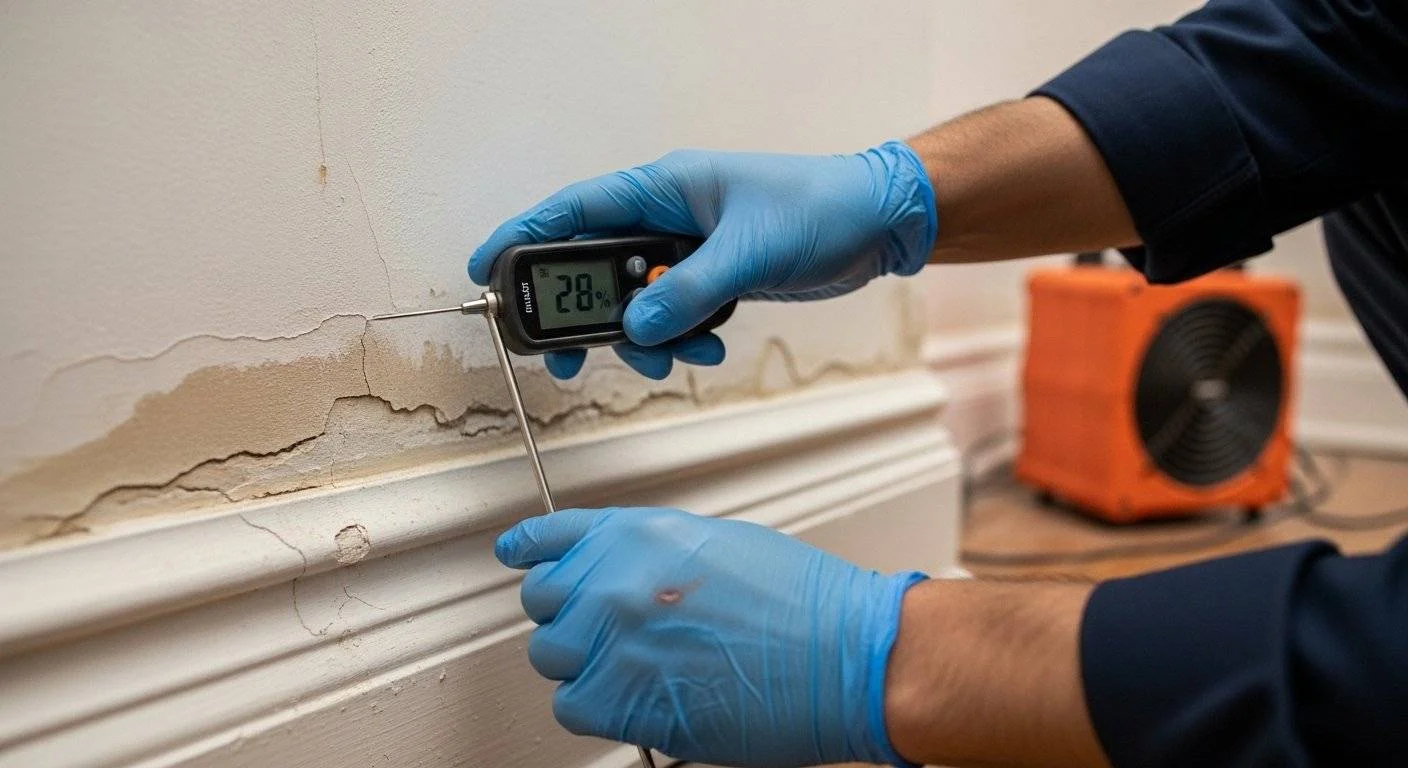
The team arrives and begins extraction while simultaneously mapping all hidden moisture with thermal imaging cameras and professional moisture meters. This assessment is the most critical step in the project. Properties where the initial assessment misses hidden moisture develop mold inside walls weeks after the visible work is done.
Extraction uses commercial equipment capable of removing hundreds of gallons before drying equipment is even positioned. For a flooded Nassau County basement or a ground-floor Queens row house, extraction alone may take several hours before conditions are stable enough to begin drying. Full details on what this phase involves are covered on our water damage restoration page.
Phase 2: Structural Drying (Days 1 Through 5 to 21, Depending on Damage Category)
This is the phase that surprises most property owners because the equipment just runs and nothing appears to happen. Structural drying is not finished when visible water is gone – it is finished when building materials reach target moisture content. IICRC S500 standards set that threshold below 16% moisture content in wood, with equivalent thresholds for concrete and masonry. That number cannot be achieved faster by adding more equipment. It follows the physics of moisture movement through materials.
Category 1 damage in a single room typically requires 3 to 5 days. Category 2 multi-room damage requires 5 to 10 days. Category 3 sewage or floodwater damage – after decontamination is complete – requires 7 to 21 days. Pre-war plaster walls, concrete basement floors that trap moisture beneath flooring, and dense construction with minimal airflow all extend drying time specifically in New York properties. Moisture readings should be documented daily and shared with you throughout this phase.
Phase 3: Contaminated Material Removal (Days 2 Through 7)
Materials that absorbed enough moisture to prevent them from reaching drying targets – or those exposed to Category 2 or 3 contamination – must be physically removed. Standard protocol for significant water damage is a flood cut: drywall removed from the floor to approximately two feet above the waterline. This opens the wall cavity, allows moisture to escape from both sides, and reveals any hidden mold growth.
All carpet and padding in affected areas comes out. Saturated insulation cannot be dried in place. In Category 3 situations, every porous material that contacted contaminated water must be removed and properly disposed of regardless of visible damage.
For NYC buildings constructed before 1978, lead paint testing may be required before demolition begins. Properties with older insulation or floor tiles may require asbestos testing. These regulatory requirements typically add one to three business days before material removal can start – a standard part of working in older New York housing stock. If mold is already present at this stage, our certified mold remediation service runs concurrently with material removal rather than after it.
Phase 4: Reconstruction – Where NYC Timelines Diverge From Every Other Market
Once structural drying is confirmed and the space is cleared, reconstruction begins. In Nassau County single-family homes with no permit requirements, this phase moves at the contractor’s schedule – three to six weeks for moderate scope.
In NYC apartments and co-ops, two delays routinely add weeks. Co-op boards require a formal alteration agreement and approval before any reconstruction work beyond emergency mitigation begins. Board review cycles typically run two to six weeks. NYC DOB permits for plumbing, electrical, or structural work add another two to six weeks under formal review. Building work-hour restrictions – typically 9 a.m. to 5 p.m. on weekdays – compress the productive hours available to contractors. For more on the specific challenges of restoring older NYC properties, see our guide to water damage in NYC pre-war buildings.

Realistic Total Timelines for NYC and Long Island Properties
Category 1 single-room damage in a NYC apartment requiring no board approval: two to three weeks from extraction through final cosmetic repair. Category 1 to 2 multi-room damage in a co-op requiring board approval and DOB permits: six to eleven weeks total. Category 3 sewage backup in a finished Nassau County basement: four to eight weeks covering decontamination, material removal, drying, and reconstruction – the full scope of which is explained on our flood damage restoration page. Major flood damage in a NYC apartment involving multiple trades, DOB permits, and co-op board processes: eight to sixteen weeks from incident to fully restored and re-occupied. These ranges reflect the market. They are not a sign of a slow contractor.
Frequently Asked Questions
Can restoration be completed faster with more equipment?
More equipment accelerates extraction but does not proportionally compress structural drying. Drying time is controlled by the moisture content of materials, ambient humidity, and airflow patterns – not equipment volume. Professional teams calibrate placement based on daily psychrometric readings. Overloading a space with equipment can create counterproductive airflow that actually extends the drying phase rather than shortening it.
Can I stay in my home during restoration?
For Category 1 damage confined to one area, residents can usually remain in unaffected portions of the property while drying equipment runs. Category 3 sewage or floodwater damage requires evacuation of the contaminated area. Your restoration team should give occupancy guidance based on the contamination type. If your policy includes Additional Living Expense coverage, document any temporary housing costs – they are reimbursable if the property is uninhabitable during restoration.
Who is responsible for water damage in a NYC co-op or condo?
It depends entirely on your proprietary lease or governing documents. Generally, the building’s master policy covers structure and common infrastructure. Unit owners cover interior finishes under their HO-6. Water originating from building infrastructure falls under the building’s insurer. Water originating within the unit falls to the unit owner. Written, time-stamped notification to building management at the moment of discovery is critical for establishing the record in multi-party claims.
Does water damage restoration always require permits in NYC?
Not always. Cosmetic repairs – painting, like-for-like drywall, standard flooring – typically do not require a permit. Work involving plumbing, electrical, or structural changes does. The DOB Emergency Work Notification process allows contractors to begin emergency repairs immediately while the formal permit application is processed in parallel.
For active water damage in Nassau County, water damage restoration in Manhasset and surrounding communities is available 24/7 with a 30-minute guaranteed response. Call Golden Touch Restoration Specialist at (347) 551-8094.Related reading: water damage restoration in Elmont, what to do in the first 24 hours after water damage, how water extraction works, water mitigation vs. remediation vs. restoration, water damage restoration costs in Elmont and how to choose a water damage restoration company.>