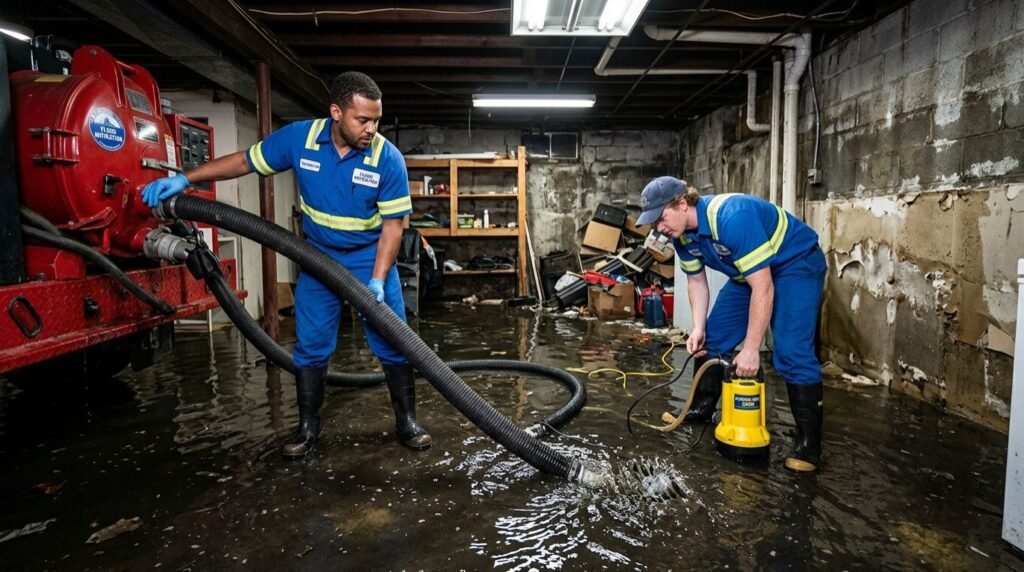
Sewage backup is the water damage emergency most homeowners are least prepared for. Unlike a burst pipe, which is typically visible and produces clean water, a sewage backup pushes Category 3 biohazardous material back through floor drains, utility sinks, or toilets – often during a storm, in the middle of the night, or while no one is home. By the time it is discovered, it has usually been sitting for hours.
This guide covers what every NYC and Nassau County homeowner needs to know: the actual health risks involved, what the professional cleanup process looks like from start to finish, and what it costs in this market. If you want to understand what happens to a property when cleanup is delayed, read our post on what happens when sewage backup goes untreated. If you are in the middle of this situation right now, go to the immediate steps section first and read the rest after you have made the call.
The Health Risks of Sewage Backup Exposure
Sewage backup is classified as Category 3 black water under IICRC S500 – the same biohazard category as natural floodwater and storm surge. It earns that classification because of its pathogen content.
The CDC identifies organisms routinely present in raw sewage: E. coli, Salmonella, Campylobacter, Leptospira bacteria, Hepatitis A virus, Norovirus, Rotavirus, Giardia lamblia, and Cryptosporidium. Exposure occurs through direct skin contact, inhalation of bioaerosols, and indirect hand-to-mouth contact. Leptospirosis can progress to liver and kidney failure in untreated cases. Sewage in enclosed spaces also releases hydrogen sulfide and methane – colorless gases that cause respiratory irritation at low concentrations and serious harm at higher ones.
Children, elderly adults, pregnant women, and immunocompromised individuals face significantly elevated risk. If any household members in these categories were present near the affected space, physician consultation is appropriate regardless of whether symptoms have appeared. Mold adds another hazard layer – sewage-saturated materials begin supporting mold growth within 24 to 48 hours. Our guide on how quickly mold can grow after water damage explains exactly why the response window is so narrow.
In NYC and Nassau County, the contamination profile has a local dimension. Approximately 60% of NYC uses combined sewer systems that route sewage and stormwater through the same pipes. During heavy rain, combined sewer overflow events push untreated sewage mixed with street runoff back through basement connections. Queens neighborhoods including Ozone Park and Cambria Heights, along with Nassau County communities like Elmont, South Floral Park, and Franklin Square, sit over aging infrastructure with this vulnerability. What comes up through the floor drain during a storm event is not solely household waste. The NYC DEP sewer backup page explains the city’s infrastructure responsibilities and how to report a backup and request an inspection.
Immediate Steps: What to Do the Moment You Discover It
Speed in the first 30 minutes determines the scope of what follows.
Leave the contaminated area immediately and keep children, elderly family members, and pets out. Turn off circuit breakers for the flooded space before re-entering – sewage water near electrical wiring, outlets, or appliances creates an electrocution hazard. Do not flush any toilets or use any drains connected to the affected line until the blockage source is identified and cleared.
Report the backup through NYC 311. This creates an official record and triggers a DEP inspection within six hours. The DEP determines whether the backup originated from the city’s main line or from your private lateral – which affects liability. Get the inspection report in writing.
Document everything with photos and video before anything is moved. Capture the waterline height on walls, all submerged items, and the full extent of floor coverage. This documentation supports both your insurance claim and any potential city claim.
Then call a professional restoration company. Do not wait for insurance guidance. Category 3 cleanup requires equipment, containment protocols, and regulated material disposal that are not available to homeowners – and your policy’s duty-to-mitigate clause requires immediate action. Our raw sewage cleanup service is available 24/7 with a 30-minute response window.

What Professional Sewage Cleanup Involves
Understanding each phase sets realistic expectations for timeline and cost.
Assessment and containment begins the moment the team arrives. Negative air pressure containment is established immediately to prevent bioaerosols from spreading into unaffected areas – running cleanup without containment causes the work itself to distribute contamination further.
Extraction removes all standing sewage water with commercial-grade equipment. Professional extraction units handle the volume of a flooded residential basement far more efficiently than any consumer tool, and they are rated for contaminated material rather than clean water.
Contaminated material removal is the step that surprises most homeowners with its scope. Every porous material that contacted Category 3 water must be removed – not dried, removed. Carpet and padding, drywall from the floor to at least two feet above the contamination line, all wall insulation in the affected zone, and any structurally saturated wood framing all come out. These materials cannot be dried in place and considered safe. Pathogens persist in organic materials even after drying. All removed material is disposed of as regulated biohazardous waste.
Antimicrobial treatment follows, applying EPA-registered disinfectants to all remaining hard surfaces – concrete floors, masonry block, metal framing – with appropriate dwell time. Structural drying then brings remaining materials to target moisture content under daily monitoring, typically running 7 to 14 days for Category 3 situations. If mold has already developed from a delayed response, our certified mold remediation service runs concurrently with the drying phase rather than after it. Final air quality and surface testing confirms clearance before reconstruction begins.
What Sewage Cleanup Costs in the NYC and Long Island Market
New York area sewage cleanup costs run approximately 9% above the national average.
| Service Component | NYC / Long Island Cost Range |
| Professional cleanup per sq ft | $7 to $15+ |
| Typical finished residential basement | $5,000 to $12,000 |
| Extensive multi-room contamination | $12,000 to $25,000+ |
| Mold remediation if response was delayed | $2,500 to $10,000 additional |
| Backwater valve installation (NYC) | $1,600 to $3,500 |
| Reconstruction after material removal | $2,000 to $15,000+ depending on scope |
Response time is the dominant cost driver. A project addressed within two hours averages $4,000 to $7,000 for most residential basements. The same project at 48 hours – with mold established – averages $10,000 to $18,000. Beyond 72 hours, $20,000 to $30,000 or more is common. Finished basements cost more than unfinished ones because they contain more porous material requiring removal. When sewage backup is combined with flooding from outside the property, the scope grows further – see our flood damage restoration page for how those situations are handled.

Does Homeowners Insurance Cover Sewage Backup?
Standard homeowners policies exclude sewage backup. Coverage requires a separate sewer backup endorsement – typically $50 to $250 annually for $5,000 to $25,000 in coverage limits. The vast majority of New York homeowners learn about this gap for the first time after their first event.
If you carry the endorsement, document everything before cleanup begins, start professional remediation immediately, and notify your insurer while the team is working. Waiting for an adjuster before cleanup risks triggering the duty-to-mitigate clause and having mold and structural damage excluded from coverage.
If the backup originated from a failure in the city’s public main, file a service request through 311, obtain the DEP inspection report, and submit a formal damage claim with the NYC Comptroller’s Office within 90 days. That deadline does not extend.
Frequently Asked Questions
How long does professional sewage cleanup take?
Extraction and decontamination of a standard residential basement typically takes one to two days. Structural drying for Category 3 situations runs seven to fourteen days. Reconstruction adds two to four weeks depending on scope and whether co-op board or permit processes apply. Total project duration: three to six weeks for most residential basements in this market.
Can I clean up sewage backup myself?
A very limited floor drain overflow with no visible sewage solids and minimal spread may be manageable with full PPE and EPA-registered disinfectants. Anything involving visible sewage contamination, strong sewage odor, or backup through a toilet or sewer line is genuine Category 3 biohazard material requiring professional remediation. The containment, extraction equipment, antimicrobial standards, and disposal requirements cannot be met with consumer tools.
How can I prevent sewage backup from happening again?
A backwater valve – a one-way check valve on your sewer lateral – is the most effective preventive measure for properties served by combined sewer systems. NYC installation requires DEP approval and costs $1,600 to $3,500. Never pour cooking grease down drains, and never flush wipes, hygiene products, or paper towels. Have your lateral inspected by camera every five to ten years, particularly in older Nassau County homes with clay or cast-iron pipe.
Is it safe to stay in the home after sewage backup?
The contaminated area must be fully vacated. If the backup is confined to the basement and no sewage odor is detectable in living areas, the upper floors may generally be occupied while cleanup proceeds. If sewage odor reaches any living space, full evacuation is recommended until professional decontamination and air quality testing confirm conditions are safe.
Golden Touch Restoration Specialist provides 24/7 sewage backup response throughout Nassau County and the five boroughs, including raw sewage cleanup in the Elmont area and all surrounding communities. Call (347) 551-8094.