When most people think about fire damage restoration, they picture cleanup – clearing out ash, wiping down walls, getting rid of the smell. That mental model is incomplete, and it leads to a very common problem: homeowners who accept restoration proposals that only address the obvious damage, then live with recurring odors, mold from water damage, deteriorating surfaces, and health consequences from incomplete soot remediation for months afterward.
Full fire damage restoration is a multi-phase process that addresses five overlapping categories of damage – not one. Understanding what a complete scope includes protects you from underscoped work and helps you evaluate whether the restoration company you hire is actually doing the full job.
The Five Categories of Damage After Any Fire
Fire events produce five distinct categories of damage that all require professional attention. A restoration scope that does not address all five is not complete.
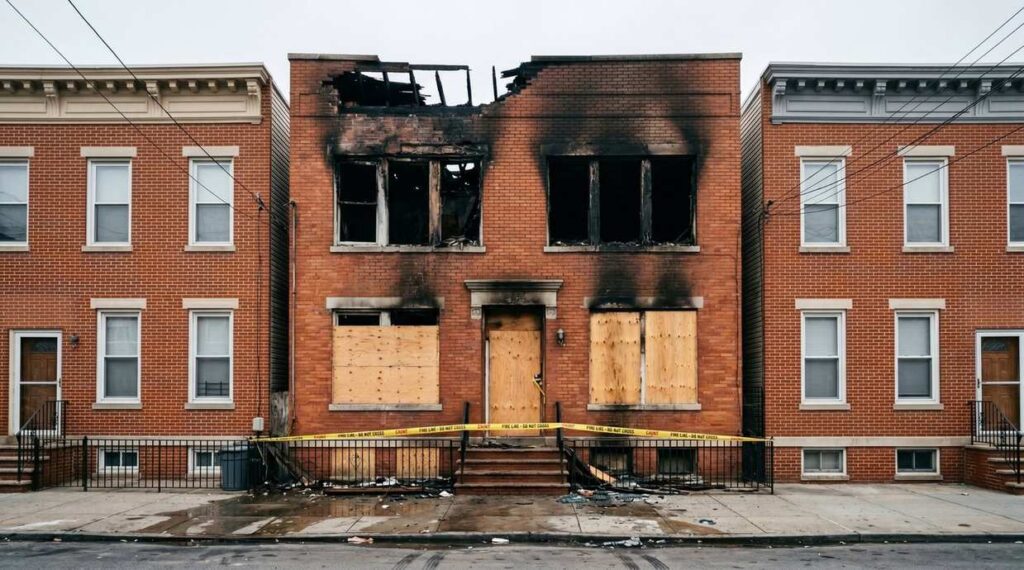
- Structural fire damage – the direct damage from flames to building components: charred framing, damaged roof assemblies, failed walls and floors. This is the most obvious and the most dramatic.
- Smoke damage – the chemical and particulate residue deposited throughout the building by smoke movement, including in rooms far from the fire. Smoke carries carcinogenic compounds and deposits them on all surfaces it contacts.
- Soot damage – the solid residue from incomplete combustion that settles on surfaces, corrodes metal, bonds with porous materials, and re-circulates through HVAC systems every time they run.
- Water damage – the result of firefighting. Large residential and commercial fires may require thousands of gallons of water to extinguish. That water saturates the structure and creates mold risk within 24 to 48 hours.
- Odor contamination – the chemical odor compounds that bond with porous building materials and off-gas for months. Standard ventilation does not remove them. They require molecular-level treatment.
Most homeowners are aware of the first two. The full scope addresses all five.
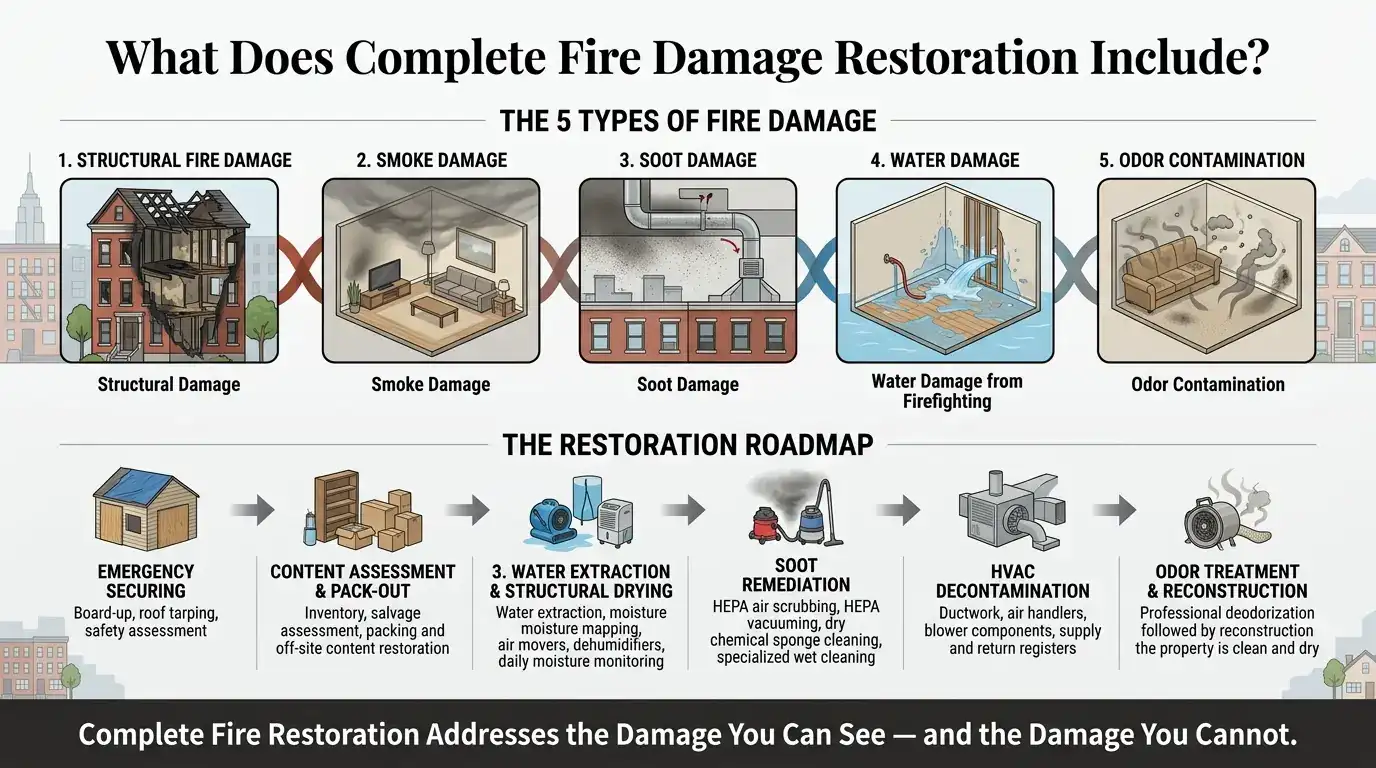
Phase 1: Emergency Securing and Access
Before any restoration work begins, the property must be assessed for safety and secured.
After FDNY clears the property for access, the restoration team’s first priority is making it structurally safe to work in and weathertight. Emergency board-up services address broken windows, damaged doors, and any structural openings that expose the building to weather, wildlife, or unauthorized entry. In NYC, where neighboring row houses are inches away and shared walls are common, securing the fire-damaged structure promptly is both a safety and liability issue.
Roof tarping over any compromised roof sections prevents rain from entering and compounding the water damage from firefighting. In New York, where weather can change within hours, leaving a compromised roof section open even briefly allows additional water intrusion that significantly expands the drying scope.
Phase 2: Content Assessment and Pack-Out
Once the building is secured, every item inside the property must be assessed: what is salvageable, what requires specialist restoration, and what must be discarded.
Salvageable items – furniture, electronics, clothing, documents, personal belongings, appliances – are inventoried and packed out for off-site restoration. Content restoration specialists use ultrasonic cleaning, ozone chambers, and specialized dry-cleaning processes to restore items that appear destroyed to homeowners. Documents, photographs, and art that were not directly in the fire may be fully recoverable through specialist treatment.
This inventory is also the foundation of your personal property insurance claim. A documented, itemized content assessment with replacement values is what your adjuster requires to process the personal property portion of the claim.
Phase 3: Water Extraction and Structural Drying
Water damage from firefighting begins producing secondary damage – mold – within 24 to 48 hours regardless of the fire damage around it. In the same building where flame damage has destroyed a room, water damage from suppression can silently produce a mold colony in an adjacent room.
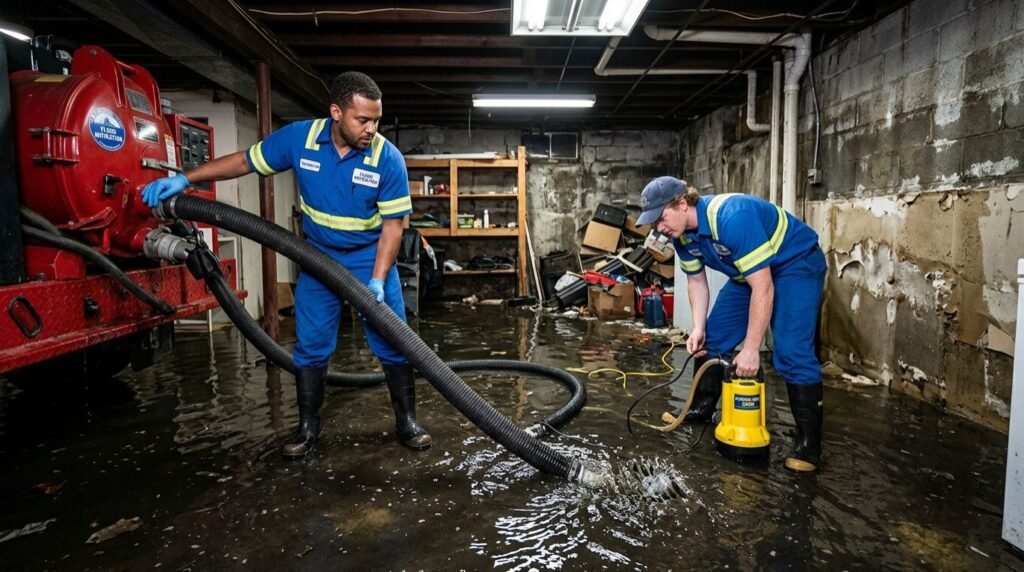
Our water damage restoration component of fire restoration includes commercial extraction of standing firefighting water, full moisture mapping of the structure to identify all wet zones, professional structural drying with commercial-grade dehumidifiers and air movers, and daily moisture monitoring until all structural materials reach IICRC target dryness. This phase runs concurrently with the soot remediation phase in areas where both are present.
In NYC, pre-war plaster walls common in older brownstones and apartment buildings hold firefighting water deeply and dry more slowly than modern drywall construction. Buildings constructed before 1978 also require lead paint and asbestos assessment before any demolition of fire-damaged or water-damaged materials can begin. Ever wondered how pros pull thousands of gallons of water out of a flooded home? Here’s how water extraction actually works.
Phase 4: Soot Remediation and Surface Cleaning
This is the most technically complex phase of fire restoration and the one most commonly underscoped by restoration proposals that focus only on obvious visible damage.
Soot remediation follows a strict sequence that cannot be shortened. HEPA air scrubbers establish and maintain air quality control throughout the work area. HEPA vacuuming removes all loose surface soot before any wet cleaning begins. Chemical dry-cleaning sponges address surface soot on walls and ceilings. Wet cleaning with formulations matched to the specific soot chemistry – dry soot, wet soot, or protein residue – follows.
Our work follows the ANSI/IICRC S700 standard throughout this phase. For the full explanation of soot chemistry and why each step in this sequence matters, see our detailed post on what soot is and why it is so dangerous.
Phase 5: HVAC Decontamination
Every fire damage restoration scope must include complete HVAC system decontamination. This is the step most frequently omitted from underscoped proposals and the one with the most lasting health consequences when missing.
From the moment the fire began, the HVAC system distributed smoke and soot particles through every connected room every time it ran. Ductwork, air handlers, blower components, and all supply and return registers carry contamination from the fire event. Cleaning walls and ceilings without addressing the HVAC guarantees that contamination continues circulating through the indoor air for months – re-depositing on surfaces that have been cleaned and re-exposing occupants to the same health hazards.
Our air duct cleaning service is a mandatory phase of every fire restoration project, not an optional add-on.
Phase 6: Odor Treatment and Reconstruction
Smoke odor is not a cosmetic problem – it is a chemical problem. Smoke compounds bond with porous building materials at a molecular level. Normal ventilation, air fresheners, and even standard cleaning cannot break those bonds. Professional odor treatment uses thermal fogging or hydroxyl generators, which produce hydroxyl radicals that break down odor molecules through oxidation. Painting over soot and smoke odors without completing the chemical deodorization phase is a documented restoration failure mode – the odors return through the fresh paint within weeks.
Reconstruction follows once all five damage categories have been addressed and clearance testing confirms the property is clean and dry. In NYC, reconstruction work requiring structural, plumbing, or electrical modifications needs DOB permits, and co-op properties require board approval before non-emergency reconstruction begins. The full restoration process – from initial board-up through final reconstruction – typically runs four to twelve weeks for residential fire events in NYC.
Frequently Asked Questions
How long does fire damage restoration take in NYC?
For a minor fire event – contained to one room, limited structural damage – four to six weeks is a realistic timeline from assessment through final reconstruction, accounting for HVAC decontamination, content restoration, and permit processes. For significant structural fires involving multiple rooms, four to twelve weeks or more is common. Administrative factors unique to NYC – DOB permits, co-op board approvals, building work-hour restrictions – consistently extend reconstruction timelines beyond national averages.
Can I stay in the property during fire damage restoration?
Usually no, at least not in the affected areas. During active soot remediation using ozone treatment, hydroxyl generators, or thermal fogging, the property must be vacated. During HEPA cleaning and structural drying phases, occupancy of adjacent undamaged areas may be possible depending on the extent of contamination. Your homeowners insurance policy’s Additional Living Expense coverage applies if the property is uninhabitable – document and claim that coverage from day one if the property requires you to stay elsewhere.
Does homeowners insurance cover the full scope of fire damage restoration?
Standard homeowners policies cover fire and smoke damage, water damage from firefighting, and loss of use if the property is uninhabitable. Content coverage applies to personal property. The complete documentation of all five damage categories – structural, smoke, soot, water, and odor – is what gives your claim the scope it needs to receive full settlement. Accepting a proposal that addresses only the visually obvious damage without full documentation of hidden soot, HVAC contamination, and smoke penetration leaves significant claim value on the table.
What is the IICRC standard for fire restoration?
The ANSI/IICRC S700 Standard for Professional Fire and Smoke Damage Restoration was published in January 2025 as the first nationally recognized American standard for fire restoration. It defines procedures for assessment, containment, soot removal, surface cleaning, HVAC decontamination, and odor treatment. When evaluating a fire restoration company, IICRC certification confirms that technicians are trained to the standard’s protocols. Learn more at the IICRC website.
Golden Touch Restoration Specialist provides complete fire damage restoration across NYC and Nassau County – from initial board-up through final reconstruction. For properties in Nassau County, our team covers fire damage restoration in Hewlett and surrounding South Shore communities. Call (347) 551-8094 for 24/7 emergency response.