
The national guidance on air duct cleaning every 3 to 5 years from the National Air Duct Cleaners Association was written for a generic American home. It was not written for a pre-war co-op on the Upper West Side, a two-family row house in Ozone Park, or a finished basement apartment in Franklin Square where the HVAC system has been pushing the same air through the same ducts for decades without anyone checking what is inside them.
The frequency question matters. But in New York, the more important question is often not “how often” – it is “has this ever been done at all.” There are specific situations common in NYC and Nassau County where the answer to when to clean your ducts is not in three to five years. It is right now.
What the NADCA Standard Actually Says
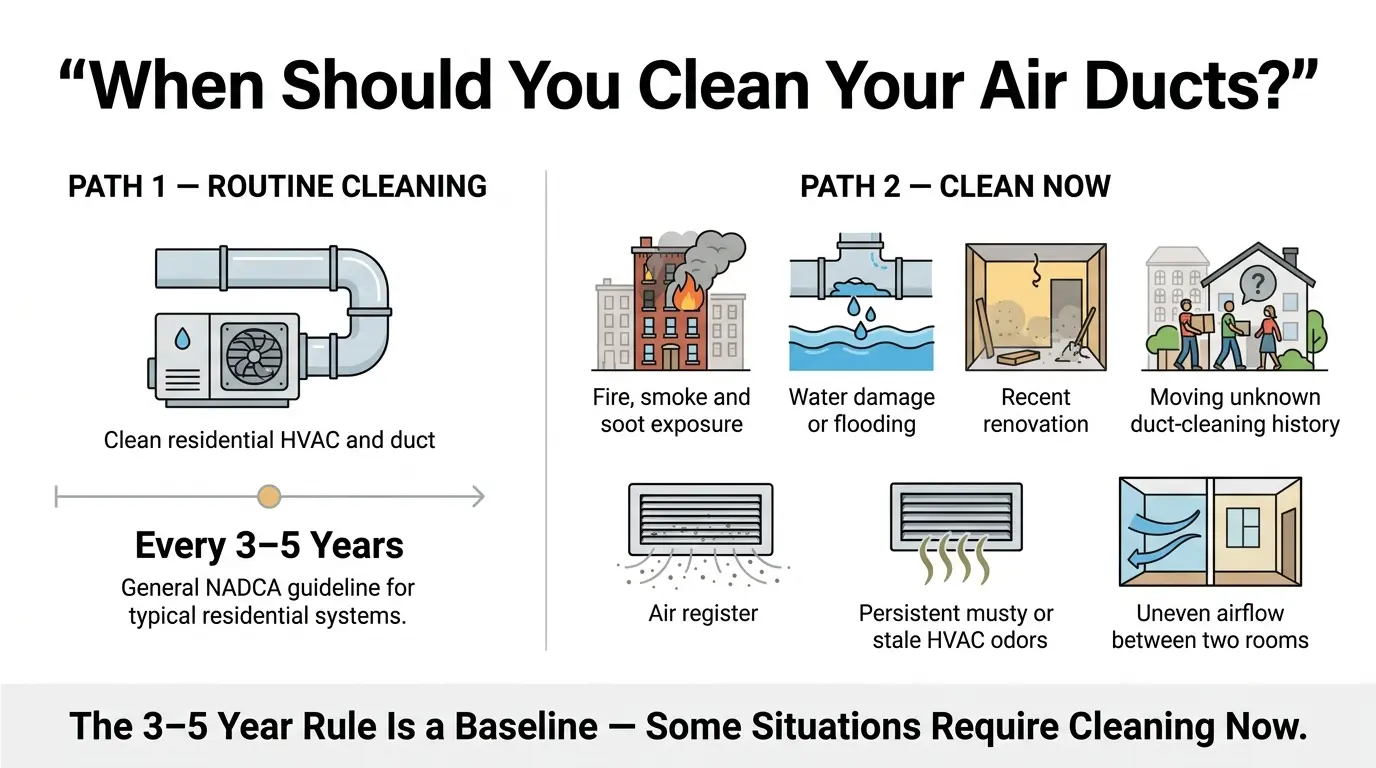
The National Air Duct Cleaners Association recommends air duct cleaning elmont every 3 to 5 years for most residential homes. That baseline assumes a reasonably modern HVAC system, no major indoor air quality events, no pets, no recent renovation, and regular filter changes. It is a reasonable starting point for a house built in the last 30 years with single-family occupancy and no recent disturbances.
In New York, those assumptions break down constantly. Pre-war buildings have duct systems that predate modern HVAC standards. Co-ops and apartment buildings share ventilation infrastructure across units. Older cast-iron and galvanized duct sections corrode and shed debris internally. New York’s density means more cooking, more indoor pollutants, and more particulate matter cycling through HVAC systems than in lower-density markets.
The EPA warns that indoor air can be 2 to 5 times more polluted than outdoor air – a statistic that applies with particular force to NYC apartment buildings where ventilation is shared and windows are often kept closed for months at a time. See our existing post on the top benefits of regular air duct cleaning for what proper maintenance actually produces in terms of indoor air quality improvement.
When the 3-to-5-Year Rule Does Not Apply
There are situations where waiting for the routine interval is the wrong call. If any of the following apply to your property, duct cleaning should happen regardless of when the last cleaning occurred.
- After any fire, smoke, or soot event. This is the most important trigger that most homeowners miss. When a fire occurs – even a small kitchen fire or a furnace puffback – the HVAC system distributes soot particles and smoke residue throughout every connected room every time it runs. Cleaning the walls and ceilings without decontaminating the ductwork guarantees that contamination continues circulating through the air for months. Our post on why smoke and soot require professional cleanup covers exactly how HVAC systems become contamination vectors after any indoor air event. HVAC decontamination is always a required component of fire damage restoration for exactly this reason.
- After water damage or flooding. When moisture enters ductwork from a roof leak, overhead pipe burst, or flooding event, mold colonization inside ducts begins within 24 to 48 hours under the right conditions. Mold inside ducts is invisible from outside but circulates spores through the entire ventilated space. If your property experienced any water intrusion near HVAC equipment, inspection and cleaning is necessary before running the system again.
- After a renovation or construction project. Construction generates drywall dust, insulation fibers, and debris that infiltrate duct systems and settle in layers that standard air filtration does not capture. If any renovation work – including neighboring unit work in an apartment building occurred while the HVAC was running, the ducts likely contain construction debris.
- When moving into a new home or apartment. If you cannot confirm the duct cleaning history of a property, schedule cleaning before extended occupancy. This applies whether the property is resale, newly vacated, or newly rented.
Signs That Your Ducts Need Cleaning Now
Rather than counting years since the last cleaning, look for these observable indicators.
Visible dust discharge from registers when the HVAC system starts particles visibly puffing into the room – indicates significant buildup inside the supply ducts. Persistent musty or stale odors that appear or intensify when the HVAC runs suggest microbial contamination or accumulated organic debris inside the system. Uneven airflow between rooms some rooms running significantly hotter or colder than the thermostat setting – can indicate blockages from debris accumulation or collapsed duct sections inside walls.
In NYC apartment buildings and co-ops, check whether neighboring units have recently experienced a fire, mold event, or renovation. Shared ventilation systems mean their indoor air quality event can become yours. For Nassau County homeowners with finished basements, the return air registers in the basement pull from the lowest point of the building and accumulate the highest concentration of particulate matter. Ever heard of moisture mapping? It’s the hidden technology restoration pros use learn what moisture mapping for water damage actually means.
What Professional Duct Cleaning Actually Involves
Professional duct cleaning certified to NADCA standards uses negative pressure equipment powerful vacuums that depressurize the entire duct system combined with agitation devices that dislodge debris from duct walls and, in contaminated systems, antimicrobial treatment applied to interior surfaces.
The process covers supply ducts, return air ducts, the air handler unit, blower components, evaporator coil, and all registers and grilles. NADCA-certified technicians inspect duct interiors with cameras before and after the process to document condition changes. In systems with mold growth, antimicrobial fog treatment follows mechanical cleaning. In post-fire situations, the cleaning protocol addresses soot chemistry specifically, using techniques different from standard dust removal. Water mitigation, remediation, restoration same thing or not? Here’s the real difference between water mitigation, remediation, and restoration.
The NYC and Long Island Factors That Accelerate the Need
Several conditions specific to this market compress the standard cleaning interval significantly.
Older buildings with original ductwork have accumulated decades of particulate matter that no amount of filter maintenance addresses. Cast-iron supply plenums, original galvanized duct runs, and uninsulated attic sections are common in pre-war buildings throughout Queens, Brooklyn, and Nassau County – all of which collect debris faster and hold it more stubbornly than modern duct materials.
Dense urban cooking environments buildings with multiple units above restaurants, or households with frequent high-heat cooking produce significantly more grease particles, combustion byproducts, and cooking aerosols that enter HVAC systems than a single-family suburban home. Nassau County homes with pets may find the 2-to-3-year interval more appropriate than the standard 3-to-5. Ever wondered how pros pull thousands of gallons of water out of a flooded home? Here’s how water extraction actually works.
Frequently Asked Questions
Is air duct cleaning a scam?
Not when performed by NADCA-certified technicians using negative pressure equipment and proper agitation. The scam version involves a standard vacuum and a quick pass through visible registers, which moves debris around without removing it. Legitimate duct cleaning takes three to six hours for a standard residential system, uses large-diameter negative pressure equipment, and can produce camera documentation before and after. Ask for proof of NADCA certification before scheduling any service. For the full certification standard, see the National Air Duct Cleaners Association directly.
Does air duct cleaning help with allergies in NYC apartments?
For occupants with dust mite sensitivity, pet dander allergies, or mold allergies, professionally cleaned ducts in a building with a history of moisture or pet occupancy can reduce the concentration of airborne allergens meaningfully. The effect is more significant in older buildings with high particulate accumulation. In buildings where shared ventilation mixes air between units, duct cleaning of the common HVAC infrastructure is the more impactful intervention.
How much does air duct cleaning cost in New York?
Professional residential duct cleaning in the NYC and Nassau County market typically runs $400 to $800 for a standard system, depending on the number of vents, system size, and accessibility. Post-fire or post-water-damage decontamination, which requires antimicrobial treatment and more intensive protocols, runs higher. Quotes below $150 to $200 for a whole-home cleaning are typically indicative of inadequate equipment that does not meet NADCA standards.
Should air ducts be cleaned after a New York apartment fire?
Yes, without exception. Any fire event – including small kitchen fires and furnace puffbacks – distributes soot and combustion byproducts through the entire duct system. Every time the HVAC runs after a fire without duct cleaning, it redistributes those particles throughout the living space. Post-fire duct cleaning is not optional maintenance. It is a required step in returning indoor air quality to pre-loss condition.
Golden Touch Restoration Specialist provides air duct cleaning as part of fire, smoke, water, and mold restoration projects across NYC and Nassau County including fire and water damage restoration in Great Neck and surrounding communities. Call (347) 551-8094.